Focus music is engineered for a specific purpose: to occupy the part of the brain that gets distracted by silence without demanding any active attention from the conscious mind. This requires a careful balance that distinguishes focus music from entertainment. The rhythm must be steady and repetitive — typically between 70 and 100 BPM, which research suggests aligns with cognitive processing speeds during concentrated work. Melodic variation should be minimal; simple, repetitive loops or arpeggiations provide just enough musical interest to prevent the mind from wandering but not enough to draw focus away from the task at hand. Dynamic contrast must be low — no sudden loud passages, no dramatic build-ups, no surprising changes that would break concentration. Vocals are generally avoided because the brain automatically processes language, which competes for cognitive resources with the work being done. The harmonic palette uses consonant chords that create a pleasant, unobtrusive backdrop, often cycling through a small set of progressions that the ear quickly learns to ignore consciously while the subconscious finds them reassuring.
Focus music has become essential for the growing remote work and digital productivity culture. Software developers and programmers use focus beats during deep coding sessions where uninterrupted concentration is critical. Students preparing for exams stream focus music for hours while studying complex material. Writers, designers, and creative professionals use focus tracks to enter and maintain flow state during extended creative work. Remote workers use focus music to create a productive environment in home offices where distractions are abundant. Companies provide focus music playlists in open-plan offices to help employees concentrate despite ambient noise. The Pomodoro technique community specifically seeks focus tracks timed to standard work intervals.
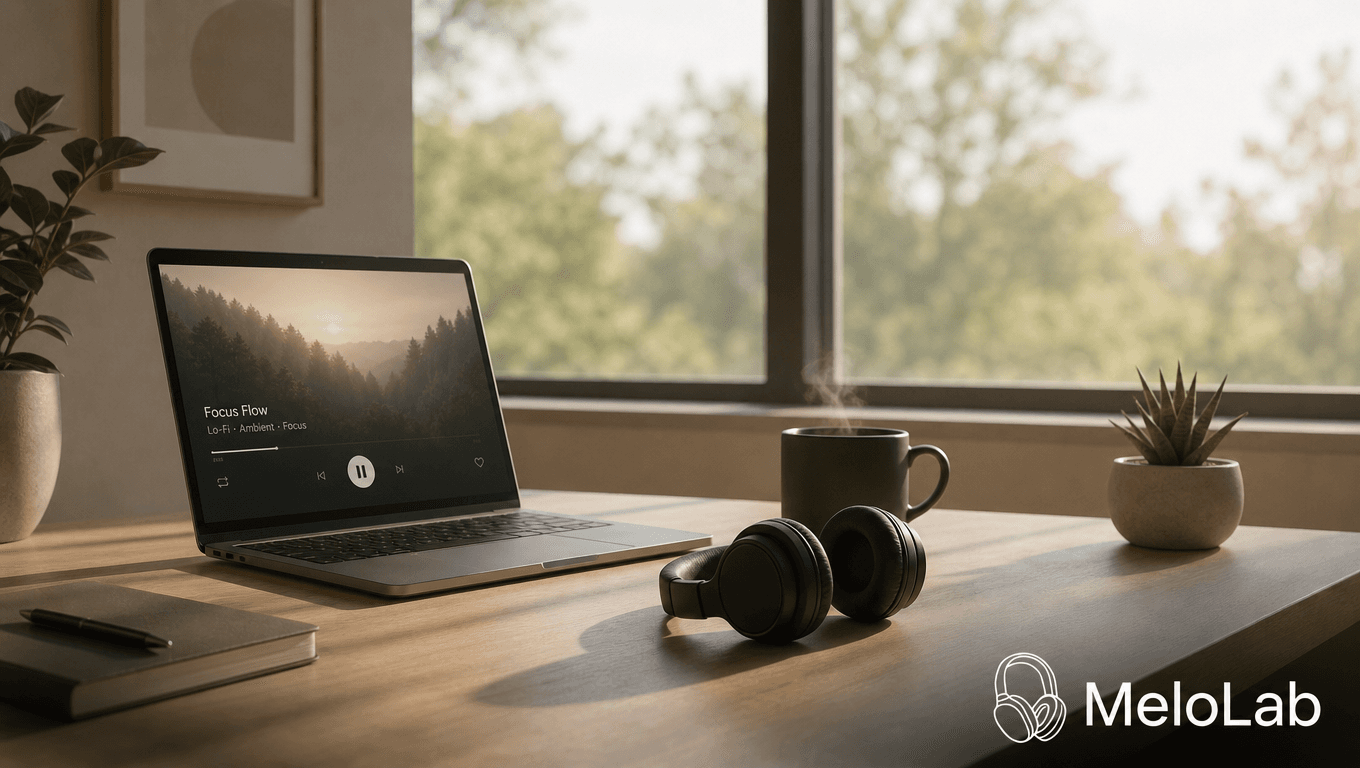
MeloLab's focus music generator creates tracks specifically optimized for concentration rather than entertainment. The AI understands the principles of distraction-free composition — steady rhythms, minimal variation, low dynamics, and no vocals. It draws from lofi, ambient, and minimal electronic traditions to produce focus music that supports extended work sessions without becoming tedious or distracting. The generator can create tracks at specific durations to match popular productivity techniques.
For the most effective focus tracks, describe the type of work you will be doing — "deep coding," "reading and note-taking," "creative writing." Specify the tempo range that works for your task — slower for reading, slightly faster for analytical work. Indicate whether you want pure ambient, lofi beats, or minimal electronic, and specify the duration you need for your work session. The more context you provide about the work environment, the better the AI can tailor the track to support your concentration.