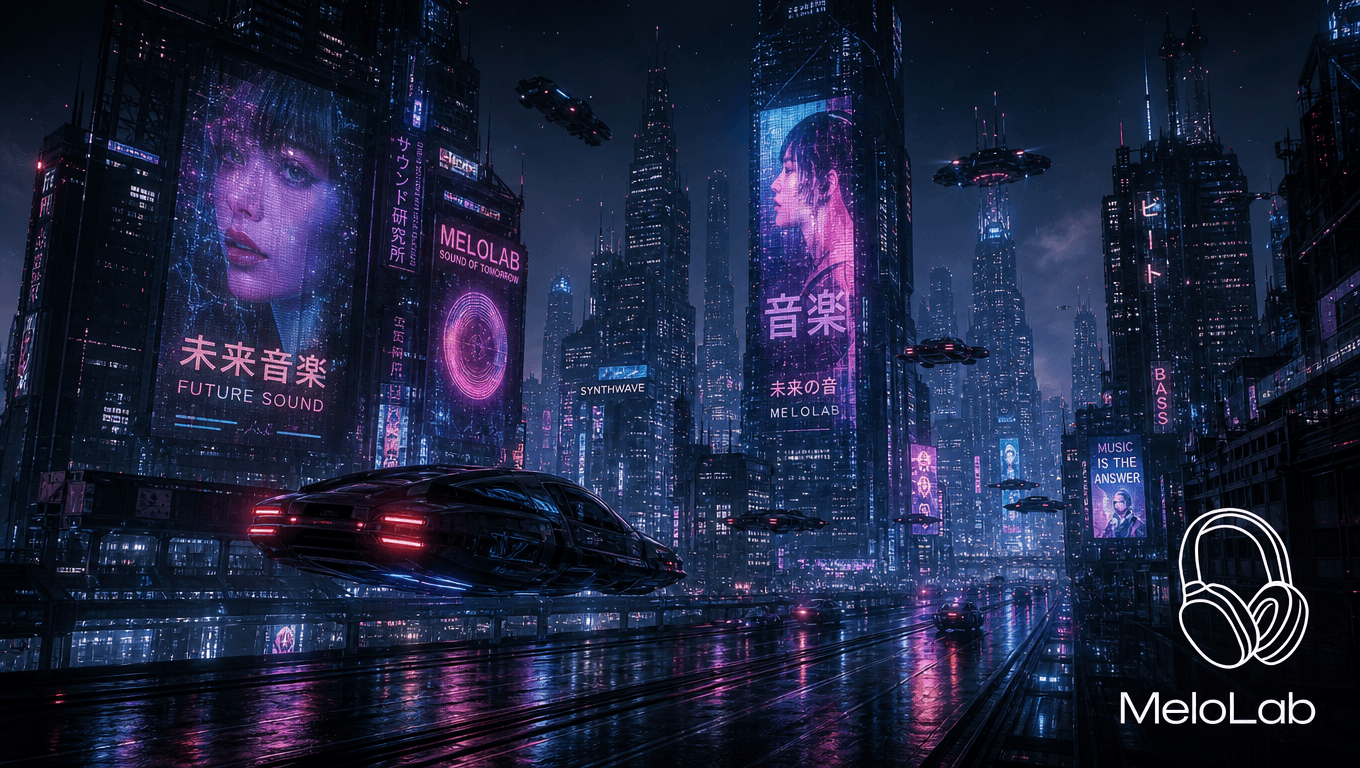
Futuristic music is the sound of worlds that do not exist yet — or at least, worlds that feel decades ahead of our own. It achieves this through extensive use of electronic and digital sound design: modular synthesizers producing complex, evolving textures; glitch effects that fracture sounds into digital shards; bit-crushing that degrades audio into lo-fi robotic timbres; and spatial processing that places sounds in impossibly vast, impossible spaces. The bass design often pushes into sub-frequency territory, creating physical vibrations that listeners feel more than hear. Metallic, robotic, and industrial timbres dominate, replacing organic warmth with cold precision. Tempos span a wide range — slow for space ambience around 80 BPM, moderate for cyberpunk beats around 95 BPM, and fast for industrial and high-energy tracks up to 140 BPM. Arpeggiated synthesizer sequences create the sense of machines processing data, while granular synthesis transforms ordinary sounds into alien textures. The result is music that sounds like it was composed by artificial intelligence for a civilization that has not been built yet.
Futuristic music is increasingly in demand as technology brands, gaming studios, and content creators embrace sci-fi aesthetics. Tech startups and software companies use futuristic music in product launch videos, app demos, and pitch presentations to convey innovation and cutting-edge capability. Video game developers working on sci-fi, cyberpunk, and space exploration titles need futuristic soundtracks that sell the illusion of advanced worlds. Film and television productions in the science fiction genre require futuristic scoring that sounds believable and immersive. Virtual reality and augmented reality experiences use futuristic ambient music to enhance immersion in digital environments. Electronic music producers in genres like cyberwave, dark synth, and future bass draw on futuristic aesthetics for their original productions.
MeloLab's futuristic music generator creates authentic sci-fi soundscapes that go beyond basic synthesizer presets. The AI understands how to design the glitch effects, sub-bass frequencies, metallic textures, and spatial processing that make music sound genuinely futuristic rather than simply electronic. Whether you need a brooding cyberpunk beat, a vast space ambient track, or a driving industrial composition, the generator delivers music that sounds like it belongs in tomorrow's world.
For the most convincing futuristic tracks, describe the specific sci-fi scenario — "rain-soaked neon cityscape," "abandoned space station," "AI consciousness awakening." Mentioning elements like glitch effects, sub-bass, modular synth sequences, or digital artifacts gives the AI specific tools to work with. Specify the tempo and energy level, and describe whether the mood should be dark and dystopian or bright and optimistic about the future.